Your Horoscope by Date of Birth: What a Real Chart Reading Looks Like
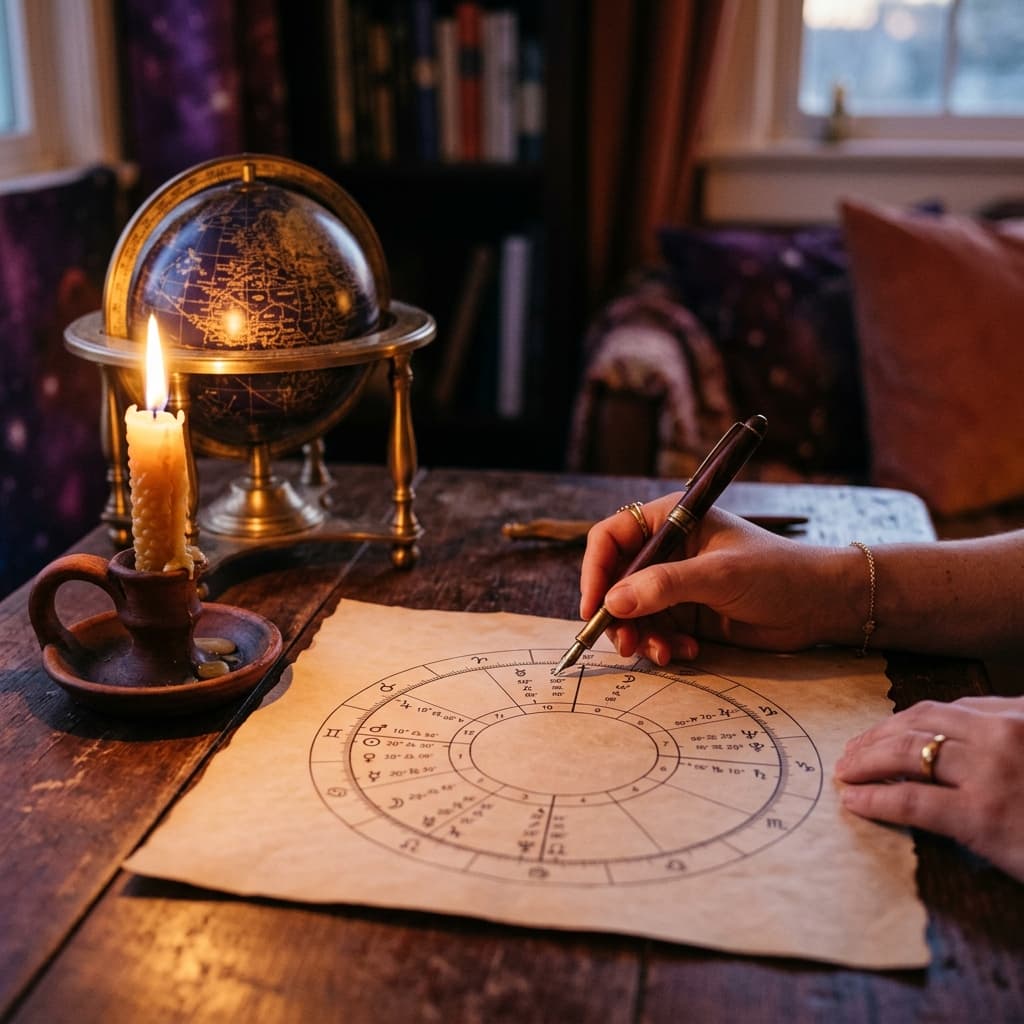
If you've ever read your horoscope — the daily column, organized by Sun sign — you've been reading a forecast written for roughly 8% of the planet. Everyone born in the same four-week window gets the same text. Sometimes it lands. It was never actually yours.
A reading built from your real date, time, and place of birth is a different thing entirely.
What Your Birth Data Actually Does
The moment you were born, every planet occupied a precise position in the sky. The Sun, in a particular sign and degree. So did the Moon, Mercury, Venus, Mars, every outer planet. The Ascendant — the degree rising on the eastern horizon — was fixed by the exact minute of your birth and the latitude of your birthplace.
All of that, gathered into one chart, is your natal chart. Unique to you the way a fingerprint is. Even twins born minutes apart can end up with meaningfully different charts — the Ascendant shifts fast, the Moon moves roughly a degree every two hours.
This is why I always push for the most precise birth time you can find. The more accurate the time, the more accurate everything built on top of it.
What a Reading Actually Covers
When I sit with someone's chart for the first time, I'm not reading a list of traits at them. I'm reading relationships: how the planets talk to each other, which houses they occupy, what condition they're working under.
A few things that come into focus:
Your Moon sign, and what it says about how you process experience. Your Sun sign is the person you're becoming. Your Moon sign is the person who already lives inside that — your emotional nature, what you need to feel secure, how you respond before you've had time to think about it.
The condition of your chart's key planets. In Hellenistic astrology, a planet isn't just its sign. It's whether it's dignified or under strain, in sect or working against the grain (day planets prefer day charts, night planets prefer night charts), well-aspected or fighting for room.
The houses, and what each one is actually governing. The 1st: your body, your approach to being alive. The 2nd: resources, livelihood. The 7th: partnership. The 10th: career, public reputation. Where the planets fall — and which houses they rule — tells you where life is concentrating its weight. (Which house a planet lands in also depends on the house system being used — whole sign vs. Placidus is not a minor setting.)
What you're working with versus what you're working through. Every chart has ease somewhere and friction somewhere else. Neither is a verdict. Some of the most striking charts I've read are the ones carrying real tension — because the person in front of me has actually been doing something with it.
Why Time of Birth Matters This Much
Without a birth time, I can still calculate a partial chart — Sun, Moon, most planetary positions — but the house structure is gone entirely. The Ascendant sets the whole frame, and it requires a time. So do the house cusps, including the Midheaven (career) and the IC (home, roots).
Don't know yours? Check the original birth certificate first — many U.S. hospitals recorded it, and vital records offices sometimes still have it on file. If it's genuinely not recoverable, chart rectification (working backward from key life events to approximate a time) is a real option. Slower, and never as certain as a clean record, but legitimate.
Beyond One Reading
A natal chart reading is a starting point, not a destination. Most clients come back to it at different points — a solar return as a birthday approaches, a transit reading when something significant is moving, a career consultation during a stretch of professional uncertainty.
The chart doesn't change. Your relationship to it does — and so do the questions you're bringing. If you're curious what yours holds, let's find out.