Whole Sign vs. Placidus: Why the House System Changes Your Reading
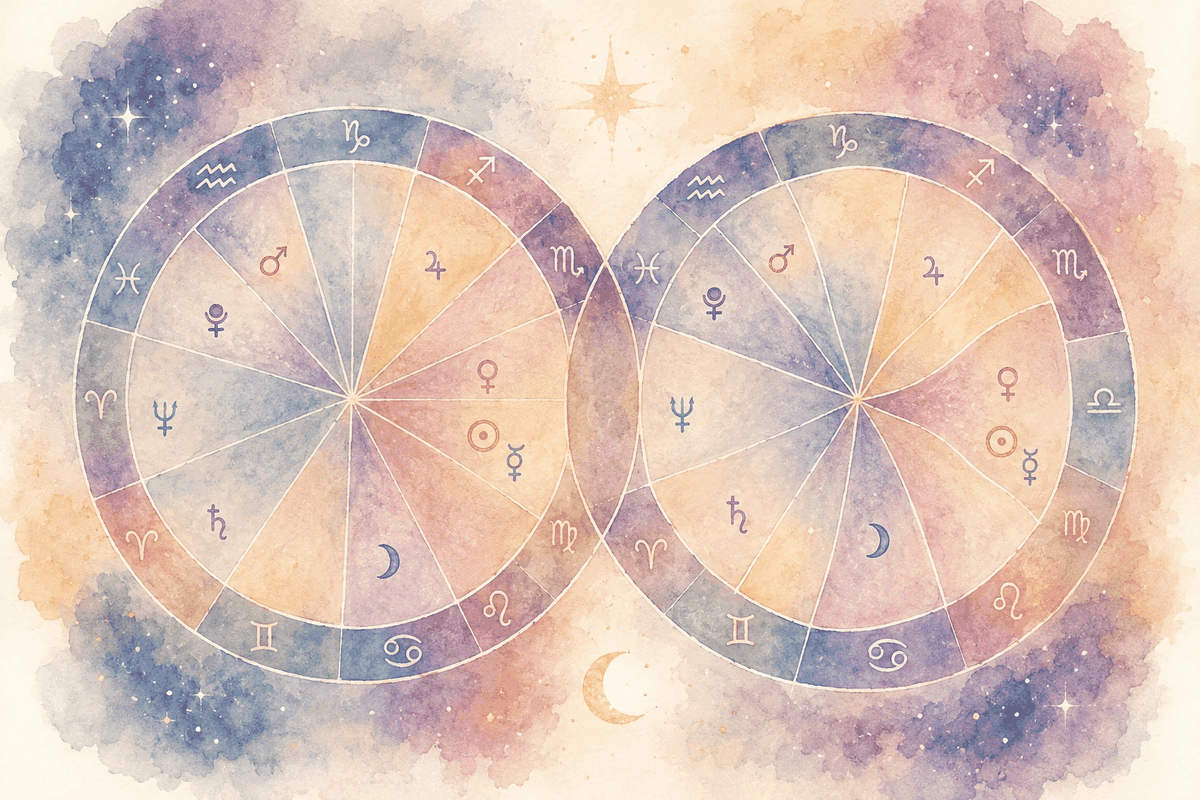
Here's something that trips people up more than almost anything else in astrology. You run your birth data through two different free chart generators and get two different charts. Same date, same time, same place. Different house placements. Sometimes a planet you were told is in your 12th house shows up in your 1st.
You didn't make an error. The two calculators are almost certainly running two different house systems, and that isn't a minor technical setting buried in an options menu. It changes what the chart actually says.
What a House System Does
Every chart divides the sky into twelve houses — 1st house of self, 7th of partnership, 10th of career, and so on. What differs between systems is how that division happens. Where the lines between houses actually get drawn.
Whole sign houses, the system I use, is the oldest approach in Western astrology and the one used throughout the Hellenistic period. It's also the simplest: whatever sign your Ascendant falls in becomes your entire 1st house, the next sign becomes your 2nd, and so on around the wheel. Every house is exactly one sign. Thirty degrees. No exceptions.
Placidus, the system most modern software defaults to, divides the sky based on the time it takes points along the ecliptic to rise, which produces houses of unequal size — some far larger than thirty degrees, others far smaller, depending on your latitude and the time of year you were born. It's a much later system, developed in the 17th century, long after whole sign was already established practice.
Why This Is Not a Small Difference
Because whole sign houses are locked to sign boundaries and Placidus houses aren't, a planet sitting near a house cusp can land in genuinely different houses depending on which system you're reading. A planet that whole sign puts solidly in your 12th house — hidden, withdrawn, working behind the scenes — might land in your 1st house under Placidus, describing something about your outward personality instead. Those aren't similar readings. They're close to opposite in meaning.
This is exactly the confusion I run into most often: someone reads about their Mars in the 12th house somewhere, checks a second source, and finds the same Mars described as 1st house. Both sources did the math correctly. They just started from different premises about how a house gets defined in the first place.
At higher latitudes, the distortion in Placidus can get severe — houses so unequal that some planets get almost no house at all to occupy for stretches of the zodiac. That's a known, documented problem with quadrant systems, and it only worsens the farther you get from the equator.
Why I Use Whole Sign
A few reasons, beyond it simply being the traditional choice. Whole sign gives every house one clear ruling planet — the ruler of the sign occupying that house — with no ambiguity from a split rulership across an unequal house. That clarity matters enormously for techniques like annual profections and zodiacal releasing, both of which I rely on for timing, and both of which were developed inside the whole sign framework to begin with. Using them on top of a different house system is a bit like translating a recipe and changing the units halfway through — technically still words, no longer reliable.
Whole sign also sidesteps the latitude distortion problem entirely. Every house is a fixed thirty degrees, regardless of where or when you were born.
None of this makes Placidus invalid. Plenty of skilled astrologers work with it, and quadrant systems have their own long, serious history. It does mean the two aren't interchangeable. If you've ever compared two chart readings and found them oddly contradictory, a house system mismatch is one of the first places I'd look.
If you're curious about other terms and techniques that show up in a reading, I keep a glossary of the language I use for exactly this kind of thing.
If you'd like your chart read with a consistent, traditional method from the ground up, a natal chart reading is where that starts.